

Image Details
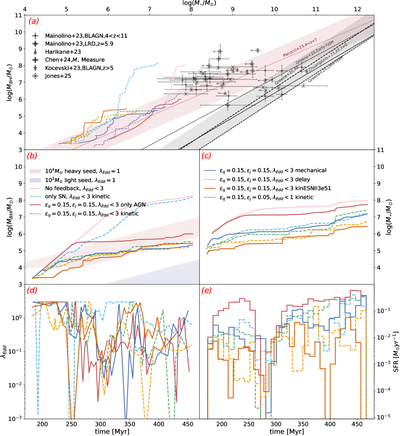
Caption: Figure 1.
(a) The MBH/M⋆ relation combining our simulations with observational constraints and empirical scaling relations. High-redshift broad-line AGNs, including so-called “little red dots” (LRDs) from R. Maiolino et al. (2024a), D. D. Kocevski et al. (2023), Y. Harikane et al. (2023), and J. Silverman et al. (2025), are shown together with six LRDs with stellar mass measurements from C.-H. Chen et al. (2025). The black dashed curves indicate the local relations for all, early-type, and late-type galaxies (J. E. Greene et al. 2020). The solid line denotes the AGN scaling relation evolved to z = 0 (M.-Y. Zhuang & L. C. Ho 2023), while the dotted curve shows the relation at 4 < z < 7 (F. Pacucci et al. 2023); shaded bands represent the 1σ intrinsic scatter. Our simulations are overplotted as evolutionary tracks in different colors (see legend): no feedback (red solid), SN kinetic (yellow dotted), AGN-only (purple solid), AGN + SN kinetic (blue dotted), AGN + SN mechanical (blue solid), AGN + SN delayed cooling (orange solid), and AGN + SN kinetic with 3 × 1051 erg (green solid). (b) BH mass growth, compared to the Eddington-limited predictions for 102 M⊙ (blue shaded) and 104 M⊙ (red shaded) seed BHs. (c) Stellar mass growth. (d) Eddington ratios, λEdd. (e) SFRs. Each feedback model uses the color and line style shown in the legend.
Other Images in This Article
Copyright and Terms & Conditions
© 2026. The Author(s). Published by the American Astronomical Society.

