

Image Details
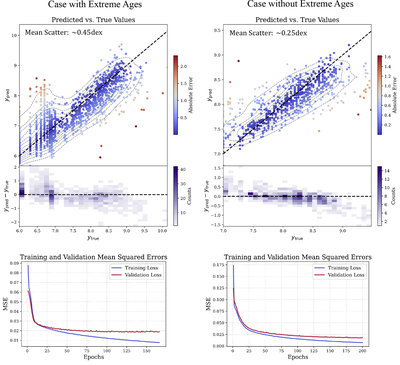
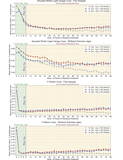
Caption: Figure 2.
CNN age prediction performance for two training samples: (left) training and evaluation on the full PHANGS-HST cluster sample and (right) training and evaluation with the youngest and oldest clusters removed. The top panels show predicted vs. reference ages, demonstrating that the CNN can indeed recover the SED-fit ages from the imaging but exhibits systematic residuals at the extreme ages. The middle panels plot residuals as a function of true age, highlighting the overestimation of very young clusters and the underestimation of very old clusters in the full-sample model. The bottom panels display training and validation MSE as a function of the number of passes through the training set. Together, these comparisons confirm the feasibility of age recovery from imaging.
Other Images in This Article
Copyright and Terms & Conditions
© 2026. The Author(s). Published by the American Astronomical Society.

