

Image Details
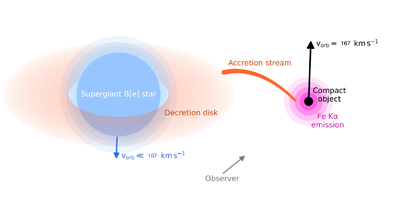
Caption: Figure 8.
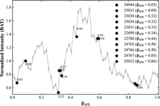
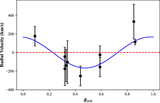
Illustration of IGR J16318−4848, showing the supergiant companion, the compact object (not to scale), and an accretion stream. The modulation of the Fe Kα line, with a velocity of ∼167 km s−1, suggests that it originates close to the compact object since the orbital velocity of the (heavier) companion around the center of mass is expected to be lower than this value. Our analysis also indicates that spectral variations likely follow an orbital-phase-locked behavior, as supported by dips in the long-term (Swift/BAT) and pointed (Chandra) observations, along with enhanced absorption and a larger Compton shoulder fraction, particularly around orbital phase ϕorb ∼ 0.33. This dip could be a geometric structure such as an accretion disk or the rim of the companion star (not shown in the sketch) occulting the X-ray emission, rather than stochastic clumps in the stellar wind.
Other Images in This Article
Copyright and Terms & Conditions
© 2026. The Author(s). Published by the American Astronomical Society.

