

Image Details
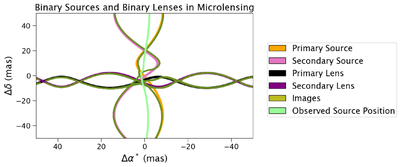
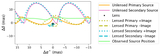
Caption: Figure 8.
Source and lens trajectories for a simulated binary-source binary-lens microlensing event with circular orbits. The orange line is the primary source, the pink line is the secondary source, the black line is the primary lens, the purple line is the secondary lens, and the yellow lines are the image positions. The green line is the flux-weighted average of lensed source positions, as observed on the sky. Note that magS,pri = 16 and magS,sec = 17. The Einstein radius is 4.9 mas. The simulation was run with tE = 231.15 days. The following orbital parameters were used for the lens: ωpri = 30°, Ωsec = 10°, i = 90°, e = 0.2, and P = 2722.46 days. The following orbital parameters were used for the source: ωpri = 30°, Ωsec = 10°, i = 90°, e = 0.4, and P = 6000 days. The lenses have respective masses of mL,p = 10 M⊙ and mL,s = 8 M⊙.
Other Images in This Article
Show More
Copyright and Terms & Conditions
© 2026. The Author(s). Published by the American Astronomical Society.

