

Image Details
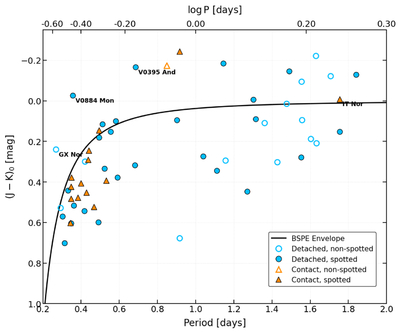
Caption: Figure 2.
Period–color diagram for the sample of 83 binary systems. The primary abscissa (bottom) denotes the orbital period P in days, while the secondary abscissa (top) provides the corresponding log P scale consistent with the functional form of absolute-magnitude calibrations S. M. Rucinski & H. W. Duerbeck (1997). The ordinate displays the intrinsic infrared color index (J − K)0. Blue circles and orange triangles represent detached and contact systems, respectively; markers containing an internal magenta square denote systems with identified stellar spot activity. The solid black line defines the blue short-period envelope (BSPE) for contact systems, modeled as (J − K)0 = 0.038P−2.1. This relation is adapted from the optical (V − I) envelope—(V − I)BSP = 0.053P−2.1—via standard color–color transformations. The intrinsic colors were recovered by correcting observed infrared indices for interstellar reddening; Gaia-derived E(BP − RP) values were converted to a color excess E(J − K) using a standard conversion ratio (specifically E(J − K) = 0.36 × E(BP − RP)) and subtracted from the observed (J − K) values to yield the dereddened (J − K)0 indices.
Other Images in This Article
Copyright and Terms & Conditions
© 2026. The Author(s). Published by the American Astronomical Society.

