

Image Details
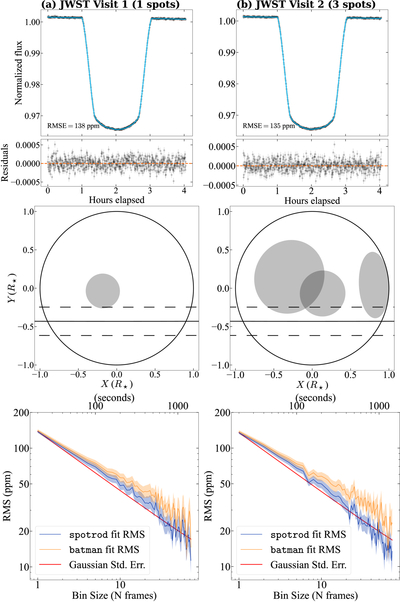
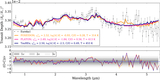
Caption: Figure 1.
Panels (a) and (b) show the JWST NIRSpec PRISM white light curves produced using Eureka1 after binning to a cadence of 20 s. Top row: the data along with the best-fitting model (solid line) with the residuals below. Middle row: the stellar surface for the adopted spot configuration. The solid line is the position of the transit chord while dashed lines reflect the planet radius. The shading of the spots is arbitrary and is not meant to convey the spot flux ratio. Bottom row: the rms for each visit for the spotrod model (blue) and spot-free model (orange) data. Gaussian white noise is shown as a red solid line. For our final reduction, we show that fitting for spots spectroscopically does not produce any significant differences in the final transmission spectra (see Appendix C). Because the wavelength-dependent transit depths generally demonstrated no sensitivity to spot crossings, we proceed with a hybrid approach in which we hold the orbital parameters constant from the spotted fit, but do not fit for the spots spectroscopically. This decision was made in order to avoid any overfitting due to higher model complexity and any degeneracies with limb darkening due to the spot on the stellar limb.
Other Images in This Article
Show More
Copyright and Terms & Conditions
© 2026. The Author(s). Published by the American Astronomical Society.

