

Image Details
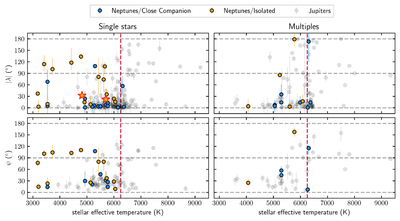
Caption: Figure 5.
Stellar obliquity of Neptune (2 ≤ Rp/R⊕ ≤ 6 or 10 ≤ Mp/M⊕ ≤ 50) and Jupiter (not Neptune with Rp/R⊕ > 6) hosts as a function of the stellar effective temperature. Top panels show the projected obliquity, while bottom panels show the true obliquity. Left panels show systems where no companion star has been reported, and right panels show known multiple-star systems. Neptunes that have planetary companions with periods between 1/5 and 5 times the period of the Neptune are shown in blue, while those without such close companions are shown in orange. Measurements performed in this work for TOI-181 and TOI-883 are highlighted as stars with a red edge and follow the same color code. Jupiters are shown in the background in black. Literature measurements come from A. M. Rossi et al. (2026) and TEPCat (J. Southworth 2011). The dashed red line demarks the Kraft break at Teff ≈ 6250 K (R. P. Kraft 1967).
Other Images in This Article
Copyright and Terms & Conditions
© 2026. The Author(s). Published by the American Astronomical Society.

