

Image Details
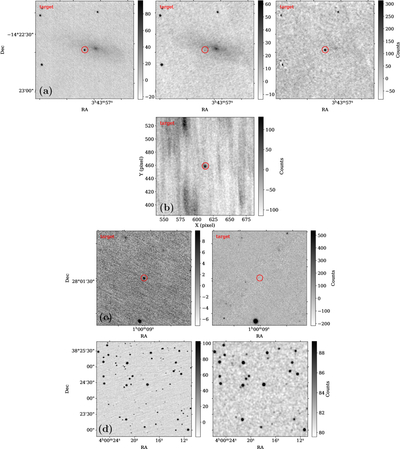
Caption: Figure 6.
SYSU 80 cm J-band images. (a) Image subtraction demonstration for SN 2024xal. Left: science (sample) image obtained on 2024 October 27 with the SYSU 80 cm telescope. Middle: reference (template) image taken on 2024 December 21, in which SN 2024xal is not detected to a 5σ limiting magnitude of 18.5 mag. Right: subtracted image (science template) clearly revealing the supernova. (b) Stacked image of 3I/ATLAS, produced by shifting 60 exposures of 20 s to align with the comet’s position on 2025 July 14. The comet is clearly detected, while the streaks are background stars. (c) Left: J-band image of the quasar J0100−28023 (z = 6.3) obtained with the SYSU 80 cm infrared telescope on 2024 November 1, with J = 16.3 mag. Right: archival Pan-STARRS g-band data, where the source is undetected down to a limiting magnitude of ∼23 mag. High-redshift quasars invisible in the optical can be detected in the NIR. (d) Portion of the stacked deep image centered on R.A. 60﹩\mathop{.}\limits^{\unicode{x000b0}}﹩077, decl. 38﹩\mathop{.}\limits^{\unicode{x000b0}}﹩405. Left: stack combining individual exposures totaling 3 hr, reaching a 5σ depth of J ∼ 20.5 mag. Right: archival 2MASS 6× Deep Survey J-band data, with a limiting magnitude of ∼17 mag.
Other Images in This Article
Copyright and Terms & Conditions
© 2026. The Author(s). Published by the American Astronomical Society.

