

Image Details
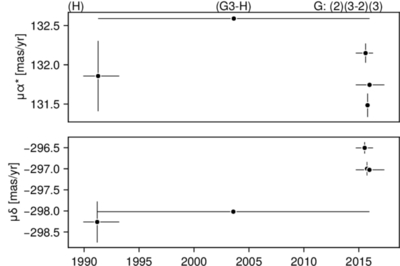
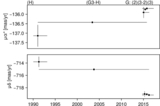
Caption: Figure 10.
Astrometric velocity points for 14 Her showing both a long-term Gaia–Hipparcos trend, attributable to 14 Her c (D. C. Bardalez Gagliuffi et al. 2025; K. Goździewski et al. 2006) with an approximately 17 yr orbital period, and significant short-term variation, attributable to 14 Her b (R. P. Butler et al. 2003) with a 4.8 yr orbital period. Without the shorter-period planet, the Gaia-derived points would look more similar to those for Gliese 229 B in Figure 9. The horizontal lines indicate the time baseline of each measurement, with the centrally propagated epochs marked by points. Labels along the top axis indicate the source of each point.
Other Images in This Article
Show More
Copyright and Terms & Conditions
© 2026. The Author(s). Published by the American Astronomical Society.

