Image Details

Choose export citation format:

TOI-6692 b: An Eccentric 130 Day Period Giant Planet with a Single Transit from TESS

  • Authors: Allyson Bieryla, Karen A. Collins, George Zhou, David W. Latham, Brad Carter, Paul Dalba, Robert Gagliano, Thomas L. Jacobs, Martti Holst Kristiansen, Daryll LaCourse, Mark Omohundro, H.M. Schwengeler, Khalid Barkaoui, Rafael Brahm, R. Paul Butler, Douglas A. Caldwell, Jeffrey D. Crane, Tansu Daylan, Sarah Deveny, Jason D. Eastman, Yadira S. Gaibor, Michaël Gillon, Thomas Henning, Keith Horne, Steve B. Howell, Emmanuel Jehin, Eric L. N. Jensen, Andrés Jordán, Michelle Kunimoto, Colin Littlefield, Léna Parc, Samuel N. Quinn, Malena Rice, Joseph E. Rodriguez, Richard P. Schwarz, Ramotholo Sefako, Stephen A. Shectman, Avi Shporer, Abderahmane Soubkiou, Gregor Srdoc, Michal Steiner, Marcelo Tala Pinto, Johanna Teske, Trifon Trifonov, Solène Ulmer-Moll, Cristilyn N. Watkins, Sharon X. Wang, Jhon Yana Galarza, Samuel W. Yee

Allyson Bieryla et al 2026 The Astronomical Journal 171 .

  • Provider: AAS Journals

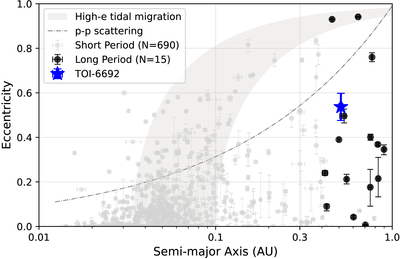
Caption: Figure 8.

All transiting exoplanets in the range of 6–20 Earth radii. Planets with periods less than 100 days are plotted in light gray, and the 16 planets with periods longer than 100 days are plotted in black. TOI-6692 b is plotted as a blue filled star. The gray region illustrates planets that are likely undergoing high-eccentricity tidal migration. The upper and lower limits of the track are set by the Roche limit and the tidal circularization timescale (J. Dong et al. 2021). The dotted–dashed line presents the theoretical upper limit of eccentricities as a result of planet–planet scattering, assuming a planet with a mass of 0.5 MJup and a radius of 2 RJup, for illustrative purposes (C. Petrovich et al. 2014). Data were obtained on 2025 August 4 from the NASA Exoplanet Archive.

Other Images in This Article
Copyright and Terms & Conditions

Additional terms of reuse