Image Details

Choose export citation format:

TOI-6692 b: An Eccentric 130 Day Period Giant Planet with a Single Transit from TESS

  • Authors: Allyson Bieryla, Karen A. Collins, George Zhou, David W. Latham, Brad Carter, Paul Dalba, Robert Gagliano, Thomas L. Jacobs, Martti Holst Kristiansen, Daryll LaCourse, Mark Omohundro, H.M. Schwengeler, Khalid Barkaoui, Rafael Brahm, R. Paul Butler, Douglas A. Caldwell, Jeffrey D. Crane, Tansu Daylan, Sarah Deveny, Jason D. Eastman, Yadira S. Gaibor, Michaël Gillon, Thomas Henning, Keith Horne, Steve B. Howell, Emmanuel Jehin, Eric L. N. Jensen, Andrés Jordán, Michelle Kunimoto, Colin Littlefield, Léna Parc, Samuel N. Quinn, Malena Rice, Joseph E. Rodriguez, Richard P. Schwarz, Ramotholo Sefako, Stephen A. Shectman, Avi Shporer, Abderahmane Soubkiou, Gregor Srdoc, Michal Steiner, Marcelo Tala Pinto, Johanna Teske, Trifon Trifonov, Solène Ulmer-Moll, Cristilyn N. Watkins, Sharon X. Wang, Jhon Yana Galarza, Samuel W. Yee

Allyson Bieryla et al 2026 The Astronomical Journal 171 .

  • Provider: AAS Journals

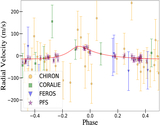
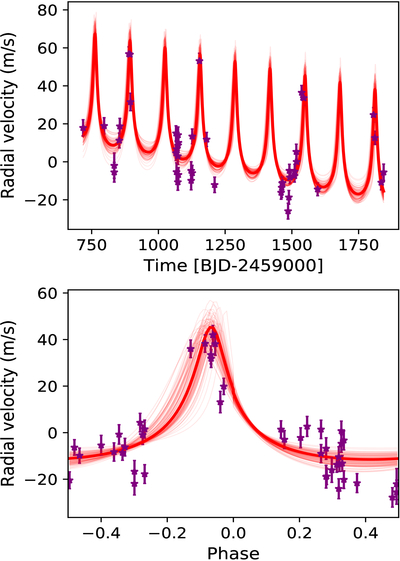
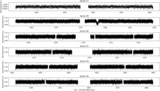
Caption: Figure 6.

Top: a linear slope showing the PFS radial velocities over time. The trend is detected at ﹩-0.028{0}_{-0.0045}^{+0.0046}\,{\rm{m}}\,{{\rm{s}}}^{-1}{{\rm{day}}}^{-1}﹩. Longer-term monitoring is necessary to confirm the orbital period of the outer companion. Bottom: PFS radial velocity observations phase folded to the ephemeris for better clarity. The solid, bold, red line is the best-fit model from EXOFASTv2 using RVs from all four facilities. The finer red lines show a small selection of draws from the converged posterior. Section 2.2 details the radial velocity observations.

Other Images in This Article
Copyright and Terms & Conditions

Additional terms of reuse