Image Details

Choose export citation format:

KMT-2025-BLG-1616Lb: First Microlensing Bound Planet From DREAMS

  • Authors: Hongjing Yang, 弘靖 杨, Weicheng Zang, 伟呈 臧, Yoon-Hyun Ryu, Takahiro Sumi, Jiyuan Zhang, 纪元 张, Hongyu Li, 弘禹 李, Cheongho Han, Yuchen Tang, Qiyue Qian, Zhixing Li, Yuxin Shang, Xikai Shan, Shude Mao, Guillermo Damke, Alfredo Zenteno, Steve Heathcote, Konstantina Boutsia, Przemek Mróz, Xiurui Zhao, Matthew Penny, Sean Terry, Patrick Tamburo, Timothy Cunningham, Quanzhi Ye, Eric W. Peng, Rachel Street, Katarzyna Kruszyńska, Etienne Bachelet, Yiannis Tsapras, Markus Hundertmark, Michael D. Albrow, Sun-Ju Chung, Andrew Gould, Kyu-Ha Hwang, Youn Kil Jung, In-Gu Shin, Yossi Shvartzvald, Jennifer C. Yee, Dong-Jin Kim, Chung-Uk Lee, Byeong-Gon Park, David P. Bennett, Ian A. Bond, Ryusei Hamada, Yuki Hirao, Asahi Idei, Shuma Makida, Shota Miyazaki, Tutumi Nagai, Togo Nagano, Seiya Nakayama, Mayu Nishio, Kansuke Nunota, Ryo Ogawa, Ryunosuke Oishi, Yui Okumoto, Nicholas J. Rattenbury, Yuki K. Satoh, Daisuke Suzuki, Motohide Tamura, Takuto Tamaoki, Hibiki Yama

Hongjing Yang et al 2026 The Astronomical Journal 171 .

  • Provider: AAS Journals

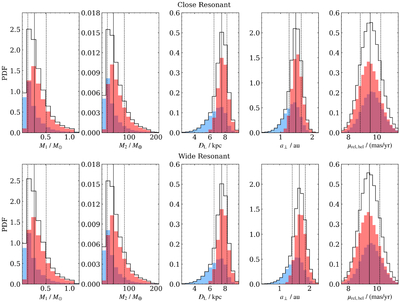
Caption: Figure 5.

Posterior probability distributions from our Bayesian analysis are shown for the host mass M1, the planetary mass M2, the lens distance DL, the projected planet-host separation a, and the heliocentric lens-source relative proper motion μhel,rel. In each panel, the solid black curve indicates the median, and the two dashed black curves mark the 15.9% and 84.1% credible limits. Contributions from bulge and disk lens populations are shown in red and blue, respectively.

Other Images in This Article
Copyright and Terms & Conditions

Additional terms of reuse