

Image Details
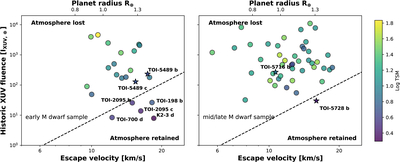
Caption: Figure 6.
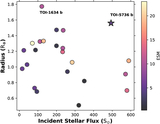
Left: the cosmic shoreline for early M dwarfs (0.36 M⊙ < M⋆ < 0.6 M⊙) from K. J. Zahnle & D. C. Catling (2017). Right: the cosmic shoreline for mid-to-late M dwarfs, as defined by E. K. Pass et al. (2025). In both panels the circles show the population of nearby (<50 pc) exoplanets with radii smaller than 1.5 R⊕ from the NASA Exoplanet Archive (accessed 2025 July 15; R. L. Akeson et al. 2013; NASA Exoplanet Archive 2024; J. L. Christiansen et al. 2025). Our targets are shown as stars. The colors of the data points correspond to their transmission spectroscopy metric (TSM). If confirmed to have an Earth-like bulk composition, TOI-5728 b would join the very small sample of rocky planets orbiting mid-to-late M dwarfs that are expected to have retained atmospheres.
Other Images in This Article
Copyright and Terms & Conditions
© 2026. The Author(s). Published by the American Astronomical Society.

