

Image Details
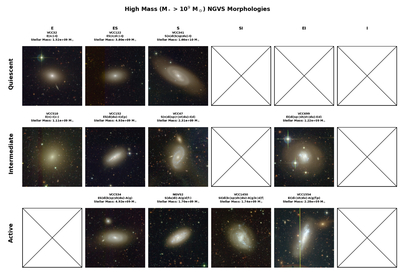
Caption: Figure 1.
A schematic illustration of the NGVS morphological classification scheme for a selection of high-mass (M* ≥ 109M⊙) galaxies. The six possible structural codes are arranged roughly from early to late types (E → S → I), including “transitional” categories (ES, SI, EI). The three rows correspond to the three possible star formation codes: Quiescent (Q), Intermediate (I), and Active (A). Galaxies are labeled by their NGVS identification number—or VCC number if the galaxy was previously cataloged in the VCC (B. Binggeli et al. 1985)—morphology and stellar mass. Empty entries in this matrix, denoted by an “X,” are either galaxies that do not exist in nature or plausibly exist but are not found in the NGVS, as explained in the text.
Other Images in This Article
Show More
Copyright and Terms & Conditions
© 2025. The Author(s). Published by the American Astronomical Society.

