Image Details

Choose export citation format:

TOI-199 b: A Well-characterized 100 day Transiting Warm Giant Planet with TTVs Seen from Antarctica

  • Authors: Melissa J. Hobson, Trifon Trifonov, Thomas Henning, Andrés Jordán, Felipe Rojas, Nestor Espinoza, Rafael Brahm, Jan Eberhardt, Matías I. Jones, Djamel Mekarnia, Diana Kossakowski, Martin Schlecker, Marcelo Tala Pinto, Pascal José Torres Miranda, Lyu Abe, Khalid Barkaoui, Philippe Bendjoya, François Bouchy, Marco Buttu, Ilaria Carleo, Karen A. Collins, Knicole D. Colón, Nicolas Crouzet, Diana Dragomir, Georgina Dransfield, Thomas Gasparetto, Robert F. Goeke, Tristan Guillot, Maximilian N. Günther, Saburo Howard, Jon M. Jenkins, Judith Korth, David W. Latham, Monika Lendl, Jack J. Lissauer, Christopher R. Mann, Ismael Mireles, George R. Ricker, Sophie Saesen, Richard P. Schwarz, S. Seager, Ramotholo Sefako, Avi Shporer, Chris Stockdale, Olga Suarez, Thiam-Guan Tan, Amaury H. M. J. Triaud, Solène Ulmer-Moll, Roland Vanderspek, Joshua N. Winn, Bill Wohler, George Zhou

Melissa J. Hobson et al 2023 The Astronomical Journal 166 .

  • Provider: AAS Journals

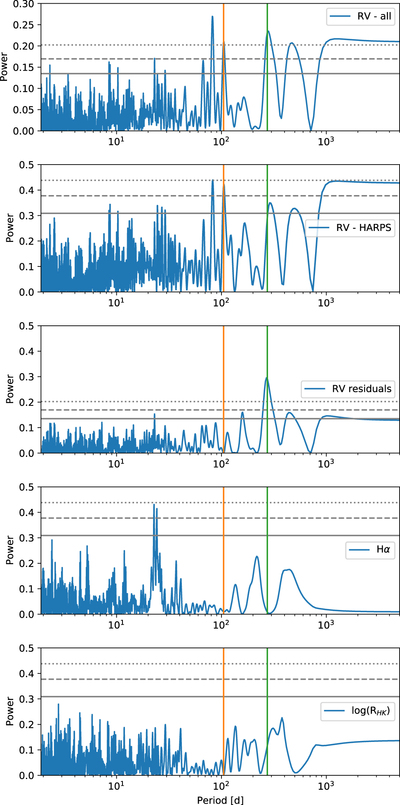
Caption: Figure 4.

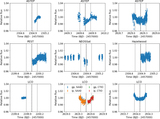
Periodograms of the joint RVs (top panel); the HARPS RVs alone (second panel); the joint RV residuals to a one-planet fit for TOI-199 b (third panel); the HARPS Hα indicator (fourth panel); and the HARPS log(﹩{R}_{\mathrm{HK}}^{{\prime} }﹩) activity indicator (bottom panel). The gray solid, dashed, and dotted horizontal lines indicate false alarm probability levels of 10%, 1%, and 0.1%, respectively. The periods of the two planets are indicated with vertical orange and green lines. We note that the peak at ∼81 days is a one year alias of the ∼104 day planet.

Other Images in This Article

Show More

Copyright and Terms & Conditions

Additional terms of reuse