Image Details

Choose export citation format:

TOI-199 b: A Well-characterized 100 day Transiting Warm Giant Planet with TTVs Seen from Antarctica

  • Authors: Melissa J. Hobson, Trifon Trifonov, Thomas Henning, Andrés Jordán, Felipe Rojas, Nestor Espinoza, Rafael Brahm, Jan Eberhardt, Matías I. Jones, Djamel Mekarnia, Diana Kossakowski, Martin Schlecker, Marcelo Tala Pinto, Pascal José Torres Miranda, Lyu Abe, Khalid Barkaoui, Philippe Bendjoya, François Bouchy, Marco Buttu, Ilaria Carleo, Karen A. Collins, Knicole D. Colón, Nicolas Crouzet, Diana Dragomir, Georgina Dransfield, Thomas Gasparetto, Robert F. Goeke, Tristan Guillot, Maximilian N. Günther, Saburo Howard, Jon M. Jenkins, Judith Korth, David W. Latham, Monika Lendl, Jack J. Lissauer, Christopher R. Mann, Ismael Mireles, George R. Ricker, Sophie Saesen, Richard P. Schwarz, S. Seager, Ramotholo Sefako, Avi Shporer, Chris Stockdale, Olga Suarez, Thiam-Guan Tan, Amaury H. M. J. Triaud, Solène Ulmer-Moll, Roland Vanderspek, Joshua N. Winn, Bill Wohler, George Zhou

Melissa J. Hobson et al 2023 The Astronomical Journal 166 .

  • Provider: AAS Journals

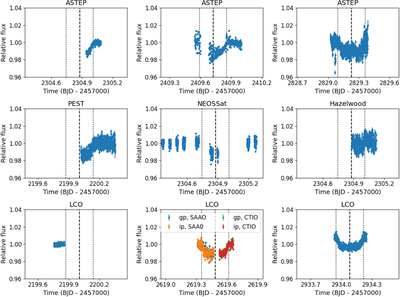
Caption: Figure 2.

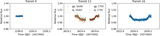
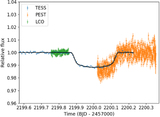
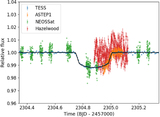
Follow-up photometry for TOI-199. Top row: light curves of ASTEP observations—an egress on 2021 March 31 (left), a full transit on 2021 July 13 (center), and a full transit on 2022 September 06 (right). Middle Row: light curves for PEST (left, egress on 2020 December 16), NEOSSat (center, full transit on 2021 March 31), and Hazelwood (right, egress on 2021 March 31) observations. Bottom row: light curves of LCO observations—a preingress flat curve on 2020 December 16 (left), two ingresses and egresses on 2022 February 08 (center), for which the points are color coded by filter and site, and a full transit on 2022 December 20 (right). In all panels, the dashed vertical line indicates the transit midpoint, and the dotted vertical lines the egress and ingress.

Other Images in This Article

Show More

Copyright and Terms & Conditions

Additional terms of reuse