

Image Details
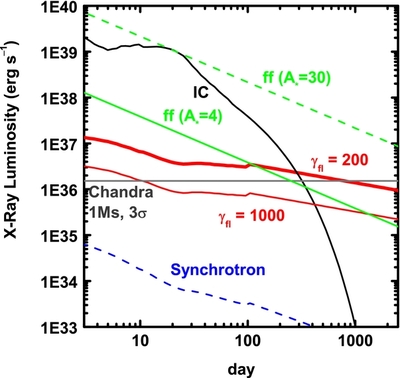
Caption: Figure 3.
Predicted long-term X-ray light curve of SN 2011dh, including the effect of possible spectral flattening. The model is the same as the "cIIb" model ( A * = 4) adopted from Maeda (2012). The IC (black) is from the same model which fits the observed X-ray light curve with the IC (Maeda 2012). The contribution from the free–free emission is shown in green, where A * = 4 (solid) is our reference model and A * = 30 (dashed) is the high-density CSM model which accounts for the early X-ray emission via free–free emission. The "original" synchrotron X-ray emission is shown with a blue dashed line. The synchrotron X-ray emission with spectral flattening is shown with red solid lines, with γ fl = 200 (thick) and γ fl = 1000 (thin). At ~10–100 days, the synchrotron X-ray light curve shows slight suppression from the expected power-law behavior due to an additional IC cooling. The 3σ detection limit of the Chandra X-ray Observatory with an exposure of 1 Ms is shown in gray. Here, we scaled the detection limit obtained for SN 2011fe (Margutti et al. 2012) to the distance to SN 2011dh and to the exposure of 1 Ms (assuming the Poisson-noise dominated).
Other Images in This Article
Copyright and Terms & Conditions
© 2013. The American Astronomical Society. All rights reserved.

