

Image Details
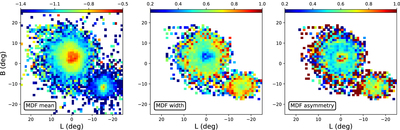
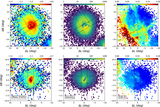
Caption: Figure 8.
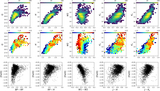
Left: average metallicity maps of the Clouds colored by mean metallicity per pixel. The central regions of the LMC are metal rich, with the region occupied by the LMC bar and dominant spiral arm. Outside the bar region, diffuse metal-rich structures are seen with an arc-like morphology in both the southern and northern regions. A negative metallicity gradient is seen through the LMC disk with apparent asymmetry; the northern and southern portions of the dwarf appear to have relatively more metal-rich stars at larger radii, and hence a flatter gradient, as opposed to the east–west direction. The outermost regions of the LMC are littered with metal-poor stars. Our metallicity predictions show the SMC to be distinctly more metal poor, with a slight gradient and central enhancement visible. Middle: we show the difference between the 90th and 10th percentile of ﹩\left[\mathrm{Fe}/{\rm{H}}\right]﹩ in each pixel, effectively a width measure of the MDF. The central regions of the LMC appear to have a relatively narrow MDF where the metal-rich bar and spiral arm dominate. Generally, the MDF of the SMC appears to be broader throughout the dwarf, in comparison to the LMC, likely owing to its large extent along the line of sight such that we are viewing a projection of multiple populations within the galaxy. Right: we color pixels by the ratio of the difference in the 95th and 50th to the difference in the 50th and 5th metallicity percentiles. A symmetric distribution would have a ratio of unity, with a left (right) skew having values below (above) this. It can be seen that regions near the LMC bar have values close to unity, a consequence of metal-rich stars being relatively more prevalent in this region acting to reduce the left skew of the MDF.
Other Images in This Article
Show More
Copyright and Terms & Conditions
© 2021. The American Astronomical Society. All rights reserved.

