

Image Details
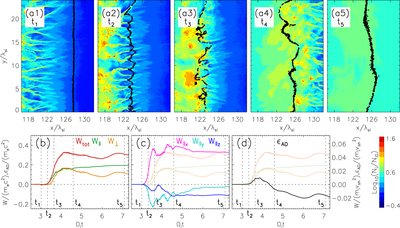
Caption: Figure 1.
Evolution of the work components of traced electrons for run B2. Panels (a1)–(a5) present the positions of traced electrons (black dots) at the time ﹩{t}_{1}\mbox{--}{t}_{5}﹩ on density maps of the shock region. Panel (b): the temporal evolution of the total work done by electric field (﹩{W}_{\mathrm{tot}}﹩, red line), the parallel work component (﹩{W}_{\parallel }﹩, green line), and the perpendicular work component (﹩{W}_{\perp }﹩, orange line). Panel (c): magenta, light blue, and dark blue lines are x- (﹩{W}_{\parallel x}﹩), y- (﹩{W}_{\parallel y}﹩), and z-components (﹩{W}_{\parallel z}﹩) of the parallel work. Panel (d): evolution of the adiabatic component (WAD; see Section 3.6). Faded curves in panels (c) and (d) represent lines from panel (b). Scales for the bottom panels are given in terms of ﹩{m}_{{\rm{e}}}{c}^{2}﹩ and ﹩{m}_{{\rm{i}}}{v}_{\mathrm{sh}}^{2}﹩. The vertical dashed lines in panels (b), (c), and (d) are time markers for ﹩{t}_{1}-{t}_{5}﹩; the horizontal dashed line is the zero level.
Other Images in This Article
Copyright and Terms & Conditions
© 2020. The American Astronomical Society. All rights reserved.

