

Image Details
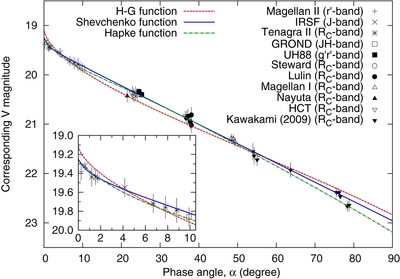
Caption: Figure 2.
Magnitude–phase relation of JU3. All observed magnitudes were converted into corresponding V magnitudes assuming the color of the asteroid in Table 2 at a hypothetical position of 1 AU from the Sun and observer. We show three models, that is, the IAU H–G function with our best-fit parameters, HV = 19.13 ± 0.03 and G = −0.006 ± 0.012, the Shevchenko function with the best-fit parameters, a = 0.21 ± 0.04, b = 0.039 ± 0.001, and HV = 19.24 ± 0.03, and the Hapke model with one of the best-fit parameter sets,  °, w = 0.041, g = −0.38, B0 = 1.43, and h = 0.050.
Other Images in This Article
Copyright and Terms & Conditions
© 2014. The American Astronomical Society. All rights reserved.

Copyright ©
2026 Astronomy Image Explorer. All Rights Reserved.
