

Image Details
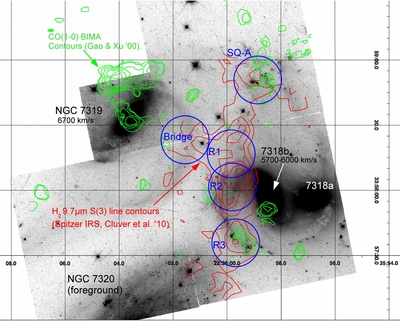
Caption: Figure 1.
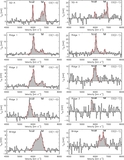
CO and H 2 observations in the Stephan's Quintet group. The gray-scale background image is a HST WFC2 V-band image. The blue circles (22 arcsec in diameter) show the IRAM 30 m CO(1–0) half-power beams where the observations presented in this paper have been taken. The corresponding spectra are shown on Figure 2. CO emission is detected at all these positions. The intruder galaxy, NGC 7318b, is colliding with intra-group gas (tidal debris from NGC 7319) at a relative velocity of ~900 km s −1. The CO(1–0) green contours from BIMA observations by Gao & Xu (2000) correspond to levels of 2.4, 3.0, 4.0, 5.0, 6.0, 7.0, and 8σ (1σ = 0.7 Jy km s −1). No CO was detected in the ridge because of limited sensitivity and bandwidth. Also note that the two ~3σ–4σ CO features in the south were just outside (but near the edge) of the BIMA primary beam. The red contours are the H 2 9.7 μm S(3) line contours from Spitzer IRS spectral mapping by Cluver et al. (2010), which clearly shows the kpc-scale shock produced by the galaxy collision. The H 2 contours are [1.0, 1.6, 2.3, 2.9, 3.6, 4.2, 4.9] × 10 −9 W m −2 sr −1.
Other Images in This Article
Copyright and Terms & Conditions
© 2012. The American Astronomical Society. All rights reserved.

