

Image Details
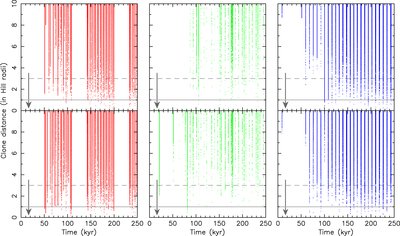
Caption: Figure 12.
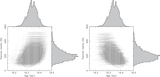
Close encounters to massive bodies in the main asteroid belt in our longer simulation: (1) clones of (6070) Rheinland at the top and (2) clones of (54827) 2001 NQ8 at the bottom. Left panels (red symbols) for encounters to the dwarf planet (1) Ceres, middle panels (green symbols) for encounters to (2) Pallas, and right panels (blue symbols) for encounters to (4) Vesta. Time at the abscissa in kyr, and distance to the massive body in terms of Hill radii of the body at the instantaneous heliocentric distance on the ordinate. The horizontal lines show a threshold of one Hill radius (solid line) and three Hill radii (dashed line). For reference, we note that the mean Hill radius of (1) Ceres is ≃220,000 km, the mean Hill radius of (2) Pallas ≃195,000 km, and the mean Hill radius of (4) Vesta is ≃125,000 km. The arrows indicate the nominal age of ≃16.3 kyr.
Other Images in This Article
Show More
Copyright and Terms & Conditions
© 2017. The American Astronomical Society. All rights reserved.

