

Image Details
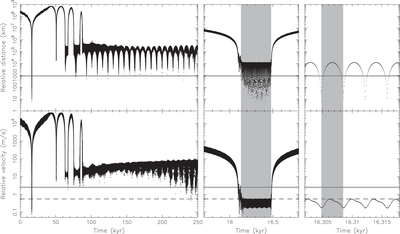
Caption: Figure 11.
Top panels: minimum distance between clones of (6070) Rheinland and (54827) 2001 NQ8 as a function of time in the past. Each of the asteroids was represented by 2000 clones and at every 0.05 years, we consider all possible identifications between the clones of the primary and secondary. The gray horizontal line shows the reference distance of 900 km corresponding to the estimate Hill radius of the parent body of the pair. Bottom panels: relative velocity of the two closest clones for which their distance was shown in the top panel. The gray horizontal line shows the reference velocity 2.5 m s−1 corresponding to the escape speed from the parent body of the pair. The dashed line shows the maximum relative velocity of the closest clones in the nominal range of ages, i.e., between 16.15 to 16.45 kyr. Middle and right columns show zoom in time to (1) the interval 15.7 to 16.8 kyr, which includes the nominal age range discussed in Section 5.1 (gray interval), and (2) the very short timescale of 16 years that includes about 4.5 orbital revolutions about the Sun. The rightmost panels indicate that the convergence occurs only at a particular phase of the revolution cycle (the gray interval shows one revolution about the Sun).
Other Images in This Article
Show More
Copyright and Terms & Conditions
© 2017. The American Astronomical Society. All rights reserved.

