

Image Details
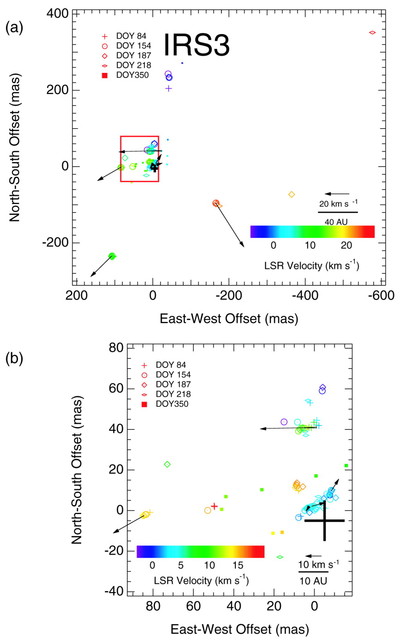
Caption: Fig. 2.
Distribution of water maser emission features in IRS 3 at four epochs in 1996 (see Table 1) and their proper motions. (a) All features, where color indicates Doppler velocity. Uncertainties in position are typically  0﹩\farcs﹩001. Arrows indicate measured proper motions. The lengths are scaled to show the expected changes in position after 9 yr. Uncertainties in proper‐motion magnitude and position angle (1 σ) are shown as tails on the arrows, where lengths indicate uncertainty in magnitude and opening angle indicates uncertainty in position angle. The uncertainties are too small to see in most cases. The black cross and filled squares indicate, respectively, the positions of the λ1.3 cm radio continuum peak and the water masers detected by Torrelles et al. (1998b) with the VLA ~4 months after the VLBA observations. The alignment of the VLA and VLBA maps is uncertain by 0﹩\farcs﹩01, as reflected in the size of the cross. The map origin is 2﹩\farcs﹩32 west and 5﹩\farcs﹩01 north of the origin for maps of IRS 1 (see Fig. 3). The red box indicates the region plotted on an expanded scale below. (b) An enlargement that better shows the masers associated with the putative protostellar disk and innermost portion of the proposed outflow cone. The arrows correspond to the expected change in feature positions after 1.5 yr.
Other Images in This Article
Copyright and Terms & Conditions
© 2002. The American Astronomical Society. All rights reserved. Printed in U.S.A.

