

Image Details
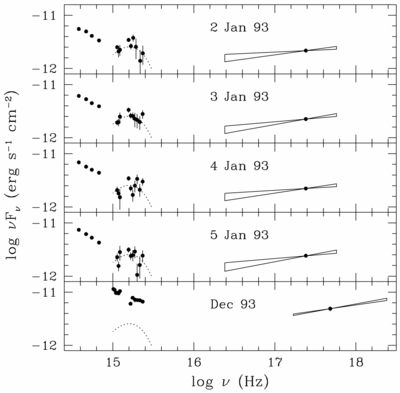
Caption: Fig. 4.
Simultaneous deabsorbed optical‐to–X‐ray spectral energy distributions of 3C 279 in a faint state, at the four epochs of IUE SWP and LWP observations in 1993 January (see Table 2), and UV‐to–X‐ray spectral energy distribution in a brighter state in 1993 December (only the SWP fluxes are simultaneous with the ASCA data; the LWP fluxes are from 1996 January; see text). The dotted curve shown in each panel represents the blackbody model that best fits the average UV spectrum of 1993 January (﹩T=20,000\pm 1000﹩ K). The possible disk component is clearly visible in the first four spectra, but disappears when the synchrotron radiation rises. The UV spectral fluxes are binned in ~100 Å wide intervals, and the 1 σ uncertainties are estimated as in Falomo et al. (1993). The best‐fit power laws to the ROSAT spectra (Sambruna 1997) and ASCA spectrum (0.7–10 keV; this paper) are shown along with their 90% confidence ranges. The optical data are from Grandi et al. (1996).
Other Images in This Article
Copyright and Terms & Conditions
© 1999. The American Astronomical Society. All rights reserved. Printed in U.S.A.

