

Image Details
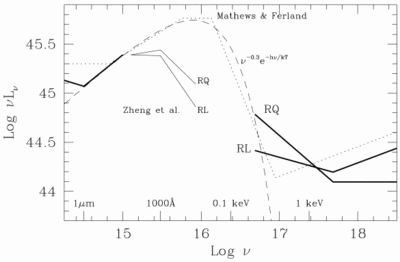
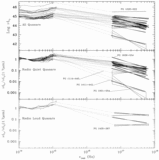
Caption: Fig. 6.
Composite optical–soft X‐ray spectrum for the RQQs and RLQs in our sample (thick solid line). The three X‐ray–weak quasars, and PG 1114+445, which is affected by a warm absorber, were excluded from the composite. The composite uses ⟨αox⟩ = 1.482(±0.025) and ⟨αx⟩ = = 1.69(±0.07) for the RQQs and ⟨αox⟩ = 1.445(±0.07) and ⟨αx⟩ = 1.22(±0.16) for the RLQs. Note that despite the fact that RLQs are brighter at 2 keV, they are fainter at 0.3 keV. The Mathews & Ferland (1987) spectral shape assumes a hard X‐ray power law down to 0.3 keV and a very steep component below 0.3 keV. This spectral shape is inconsistent with the PSPC results. The far‐UV emission can be parameterized as a cutoff power law. The spectrum shown here has Tcut = 5 × 10⁵ K, which is close to the upper limit on Tcut. The Zheng et al. (1996) FUV composites for RLQs and RQQs are plotted in a thin solid line. They suggest that the FUV power law extends into the soft X‐ray regime, with no extreme UV spectral break and no steep soft component below 0.2 keV.
Other Images in This Article

Copyright and Terms & Conditions
© 1997. The American Astronomical Society. All rights reserved. Printed in U.S.A.

