

Image Details
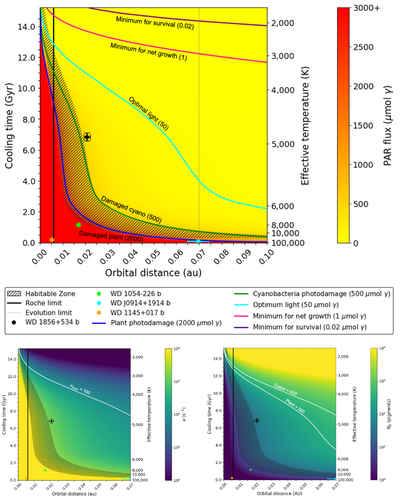
Caption: Figure 1.
Top: PAR flux as a function of orbital distance and cooling time for a typical 0.6 M⊙ white dwarf. PAR flux is expressed in units of μmol γ, where 1 μmol γ = 1 μmol photons m−2 s−1. The habitable zone is shown as the hatched region. The Roche limit is shown as a vertical solid line at ∼0.006 au, while the evolutionary limit is shown as a vertical dashed line at ∼0.07 au, corresponding to a habitable lifetime ≳1 Gyr (A. H. Knoll & M. A. Nowak 2017). Contours indicate photosynthetic and photodamage thresholds. Known planets and candidate planetary systems around ∼0.6 M⊙ white dwarfs are shown as crosses (A. Vanderburg et al. 2015, 2020; B. T. Gänsicke et al. 2019; J. Farihi et al. 2022; M. A. Limbach et al. 2025); error bars denote uncertainties in stellar temperature and orbital distance. Bottom left: energy delivery rate, ν. The white contour indicates νmax = 100 s−1, the maximum photosynthetic turnover rate. Bottom right: antenna size, Np, required to maintain νmax = 100 s−1. Contours indicate typical antenna sizes of terrestrial plants (Np = 300) and cyanobacteria (Np = 600).
Copyright and Terms & Conditions
© 2026. The Author(s). Published by the American Astronomical Society.

