

Image Details
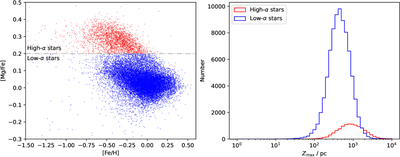
Caption: Figure 1.
A sample of 93,203 stars from APOGEE DR17 (Abdurro’uf et al. 2022), cut to a cylindrical Solar neighborhood of radius 500 pc with Teff ≥ 4500 K and ﹩{\rm{EXTRATARG}}=0﹩ for well-measured abundances (H. Jönsson et al. 2020). Survey selection biases have not been accounted for. Though there are two distinct populations in chemistry (left), these are not distinct in kinematics, illustrated with their distributions in ﹩{Z}_{{\rm{\max }}}﹩ (right), the maximum vertical height of each star’s Galactic orbit. Thus, most ISOs cannot be confidently assigned to either chemical population based on kinematics alone.
Copyright and Terms & Conditions
© 2026. The Author(s). Published by the American Astronomical Society.

