
Image Details
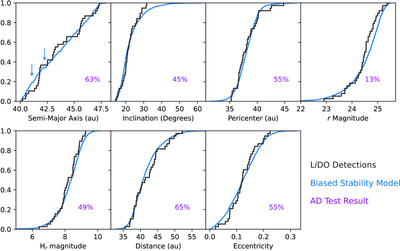
Caption: Figure 13.
Cumulative distributions of LiDO TNOs and survey simulator biased model objects from our stability-sculpted hot classical TNO model, in seven orbital element/magnitude parameters: semimajor axis a, inclination i, pericenter distance q, magnitude in r-band mr, absolute magnitude Hr, distance at detection d, and eccentricity e. Several gaps in a are apparent in the real detections (black). The biased model (blue) produces a noticeable gap in a at ∼42.5 au, and a narrow gap at ∼41 au, indicated by blue arrows in the upper left panel. These gap positions match the real object gaps, but the width is considerably narrower. Overall, the a-distribution of the stability-sculpted model has some clear structural similarities as well as noticeable differences compared to the real LiDO tno a-distribution. This includes structures in the real TNO e-distribution that are not all reflected in the biased model. The AD statistic percentages for each parameter are shown in the relevant plots, and all are >5% and therefore nonrejectable.
Other Images in This Article
Show More
Copyright and Terms & Conditions
© 2026. The Author(s). Published by the American Astronomical Society.

