
Image Details
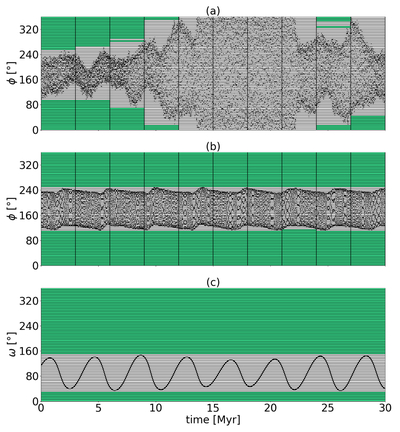
Caption: Figure 3.
Demonstration of the classification method. The resonant angle vs. time (panel (a) and (b)) is split into windows in time and bins in angle; in each time window, it is counted which angle bins are populated. If the object does not span all angles within a window, it is labeled as likely resonant in that window. The TNO in panel (a) is resonant for some of the windows, and the TNO in panel (b) is resonant for all windows shown. Panel (c) shows the classification method for detecting Kozai resonance by analyzing the argument of pericenter vs. time. However in this case, the data is not windowed in the time direction, as the libration of ω occurs on a significantly longer timescale; windowing would result in many false positives.
Other Images in This Article
Show More
Copyright and Terms & Conditions
© 2026. The Author(s). Published by the American Astronomical Society.

