

Image Details
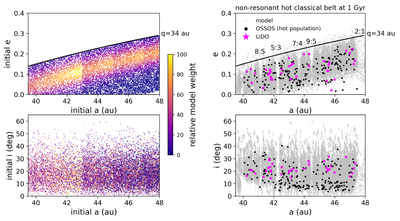
Caption: Figure 11.
Left panels: hot classical region test particle initial conditions in eccentricity vs. semimajor axis (top) and inclination vs. semimajor axis (bottom). Each test particle is color coded by its weight in our parameterized model for the hot classical region’s initial filling; note that the abrupt changes in weighting factors at distinct semimajor axis values is simply a correction factor that smooths the semimajor axis distribution relative to how we selected the boundaries of initial bins for simulation initialization purposes and not abrupt changes in the final model. Right panels: stability-sculpted hot classical population after 1 Gyr of evolution with surviving resonant and scattering particles removed; surviving particles were cloned according to their model weight. The hot classical detections from OSSOS (black circles) and LiDO (pink stars) are shown for comparison. We label some of the significant classical belt resonances that have clearly associated gaps in the top right panel.
Other Images in This Article
Show More
Copyright and Terms & Conditions
© 2026. The Author(s). Published by the American Astronomical Society.

