

Image Details
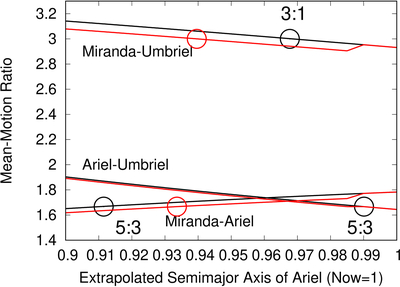
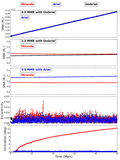
Caption: Figure 5.
Past two-body MMRs potentially encountered by the major Uranian satellites during tidal migration. Rather than using absolute time, the horizontal axis is the extrapolated semimajor axis of Ariel normalized to its present value, with aA = 1 corresponding to Ariel’s current orbit. Because Ariel is the fastest migrating of the major moons, this parameter provides a convenient proxy for the system’s dynamical age. The black curves trace the evolution of the Miranda–Umbriel and Ariel–Umbriel period ratios as the system is evolved backward through progressively smaller values of aA. Circles mark the locations of important commensurabilities, including the Miranda–Umbriel 3:1 and Ariel–Umbriel 5:3 resonances. The red trajectories illustrate the dynamical consequences of the Ariel–Umbriel 5:3 resonance, including temporary parallel migration of Ariel and Umbriel and the inward drift of Miranda driven by tidal coupling among the satellites. This figure emphasizes that the Ariel–Umbriel 5:3 resonance is not merely one resonance among many but the most consequential recent dynamical event in the system, capable of reorganizing the orbital architecture and indirectly exciting Miranda’s orbit.
Other Images in This Article
Copyright and Terms & Conditions
© 2026. The Author(s). Published by the American Astronomical Society.

