

Image Details
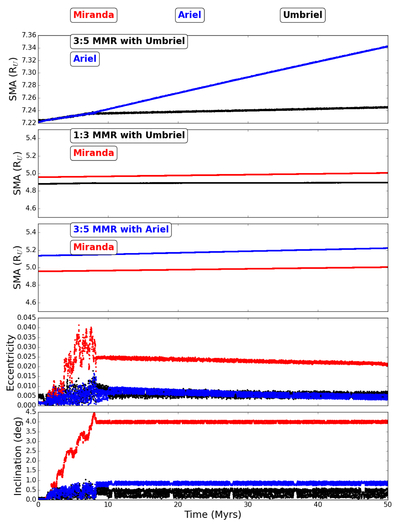
Caption: Figure 1.
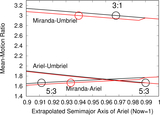
Representative SIMPL integration for (k2,M, k2,A) = (0.1, 0.1) and QU = 600, following the strong-dissipation estimate of R. A. Jacobson & R. S. Park (2025). The simulation shows the coupled orbital evolution of the Uranian satellites. The Miranda–Ariel 5:3 resonance is not encountered during the migration evolution. Instead, the evolution is dominated by the Ariel–Umbriel 5:3 MMR, during which the eccentricities and inclinations of the satellites are strongly excited. In particular, Miranda’s eccentricity reaches ∼0.04, and its inclination is excited to values comparable to its present value, despite Miranda not being a member of the primary Ariel–Umbriel resonance.
Other Images in This Article
Copyright and Terms & Conditions
© 2026. The Author(s). Published by the American Astronomical Society.

