

Image Details
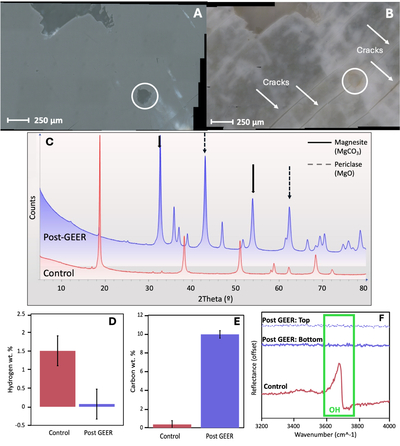
Caption: Figure 3.
Brucite breaks down due to exposure to simulated Venusian conditions. (A) An inverted microscope image of brucite before exposure, and (B) after exposure. The white circle in both (A) and (B) highlights the same cavity in the sample. After exposure, the change in texture is distinct, and linear cracks are visible due to dehydration. (C) The results of XRD analysis of the brucite powder before and after exposure in the GEER. The original sample was mostly brucite, but after exposure, magnesite and periclase are also present. The brucite powder (D) lost hydrogen, but (E) gained carbon after exposure, indicating the loss of OH and formation of carbonate. (F) FTIR-ATR spectra of the brucite powder before exposure and after exposure. Note that “top” represents powder that was present at the top of the crucible, and “bottom” is the powder at the bottom of the crucible. The OH peak located around 3680 cm−1 is no longer present after exposure.
Other Images in This Article
Copyright and Terms & Conditions
© 2026. The Author(s). Published by the American Astronomical Society.

