

Image Details
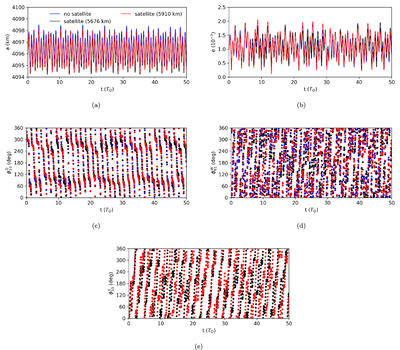
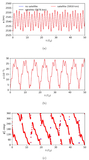
Caption: Figure 5.
Temporal evolution of the orbital elements and resonant angles of a test particle initially placed at the radial center of Q1R. Blue curves correspond to the configuration with only Weywot in the system, black curves to the configuration including a putative satellite at 5676 km, and red curves to the configuration including a putative satellite at 5910 km. Panels (a) and (b) show the semimajor axis and eccentricity evolution, respectively. Panels (c), (d), and (e) show the resonant angles of the 1:3 SOR with Quaoar, the 6:1 MMR with Weywot, and the 5:3 MMR with the putative satellite, respectively. The resonant angles are defined as ﹩{\phi }_{13}^{Q}=3\lambda -\frac{2\pi }{{T}_{Q}}t-2\varpi ﹩, ﹩{\phi }_{61}^{W}=6\lambda -{\lambda }_{w}-5\varpi ﹩, and ﹩{\phi }_{53}^{S}=5\lambda -3{\lambda }_{s}-2{\varpi }_{s}﹩, where λ, λw, and λs denote the mean longitudes of the particle, Weywot, and the putative satellite, respectively, and ϖ and ϖs are the longitudes of pericenter of the particle and putative satellite, respectively.
Other Images in This Article
Copyright and Terms & Conditions
© 2026. The Author(s). Published by the American Astronomical Society.

