

Image Details
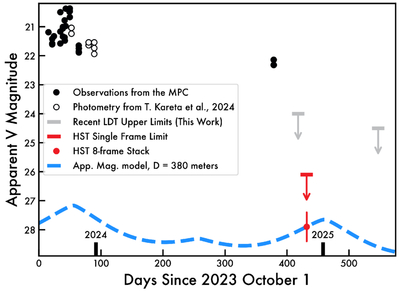
Caption: Figure 2.
A secular light curve (e.g., apparent magnitude over time) of V6 is shown with data accepted by the MPC (black filled circles) and the dataset of T. Kareta et al. (2024; black open circles). Our recent unsuccessful searches for V6 with the LDT are shown as upper limits in gray, while our HST data—both single-frame upper limits on the brightness of the object and our candidate detection in the stacked HST data at mv ≈ 27.9—are shown in red. A simple model predicting the brightness of the nucleus alone based on the brightness of the object in our stacked HST image is shown as a blue line. All observations were converted to Johnson V for consistency using the colors of the Sun, and thus some of the scatter is related to the fact that V6 does not have perfectly Sun-like colors. All observations prior to the HST observations are significantly brighter than the nucleus alone would have been. Activity peaked in the days prior to and around perihelion in 2023 November and then ceased sometime between 2024 October and December. The comet then subsequently either fragmented or turned off sometime in 2024 October or November.
Other Images in This Article
Copyright and Terms & Conditions
© 2026. The Author(s). Published by the American Astronomical Society.

