

Image Details
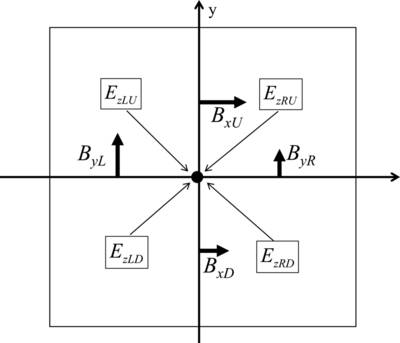
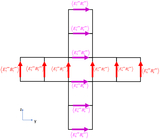
Caption: Figure 5.
Four zones in the xy-plane that come together at the z-edge of a three-dimensional mesh. Since the mesh is viewed from the top in plan view, the z-edge is shown by the black dot and the four abutting zones are shown as four squares. The four incoming states have subscripts given by “RU” for right upper; “LU” for left upper; “LD” for left down and “RD” for right down. The thin oblique arrows indicate that higher-order interpolation can eventually be used to obtain the centered part of the electric field at the z-edge. The thick horizontal and vertical arrows denote the normal components of the magnetic field at the zone faces. Owing to the divergence constraint, these field components are continuous across zone faces. They can, therefore, be obtained from the higher-order facial reconstruction of the normal component of the magnetic field within each face. This provides higher-order values of the x- and y-components of the magnetic field at the z-edge that minimize the dissipation terms.
Other Images in This Article
Show More
Copyright and Terms & Conditions
© 2026. The Author(s). Published by the American Astronomical Society.

