

Image Details
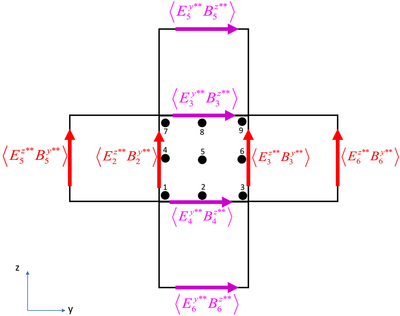
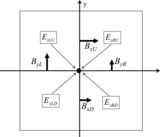
Caption: Figure 3.
The same x-face that was highlighted in Figure 2. But now we show all the nodal points in the x-face with numerically labeled dots. At these nodal points, one-dimensional Riemann solvers are invoked so that we can use the electric and magnetic fields from those Riemann solvers to construct a fourth-order accurate face-averaged Poynting flux. However, recall that the red and magenta arrows also show the z-edge aligned and y-edge aligned electric fields that are obtained from a two-dimensional Riemann solver. The two-dimensional Riemann solver also yields the transverse magnetic fields. These have been used to obtain the angled brackets, which represent line integrals of the relevant products along each edge. In the text, we show how these angled brackets are combined to obtain a fourth-order accurate Poynting flux at the x-face that is exclusively based on the edge-centered information. This Poynting flux is more consistent with the update of the face-centered magnetic fields. It should, therefore, replace the Poynting flux that is based on the one-dimensional Riemann solvers.
Other Images in This Article
Show More
Copyright and Terms & Conditions
© 2026. The Author(s). Published by the American Astronomical Society.

