
Image Details
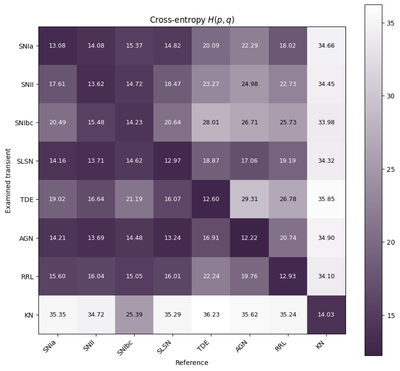
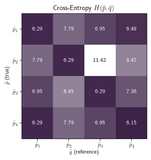
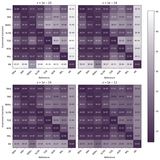
Caption: Figure 3.
Pair-wise cross entropies H(p, q) computed globally between Presto-Color distributions for eight transient populations. Each entry represents the expected surprisal of observations drawn from population p when encoded using the distribution of population q. Diagonal terms correspond to self-cross entropies, while off-diagonal terms quantify population-level dissimilarity. Larger values indicate higher dissimilarities. The matrix indicates that SN subclasses exhibit strong mutual similarity, as expected from their related photometric evolution. Although AGN, TDE, and RRL variability arises from fundamentally different physical mechanisms, their cadence-conditioned photometric distribution occupies a compact region that lies within or near regions of nonnegligible support in the SN distributions, resulting in comparatively lower cross-entropy values. In contrast, the KN population is remarkably dissimilar from all other classes, with consistently high cross entropies, reflecting its localization in a distinct region of observable phase space with minimal overlap under the adopted cadence (see Figures 1 and 2). Note that due to the asymmetry of DKL(p∣∣q), the matrix is not symmetric and the relevant surprisal scores for a transient population CX should be read along the CX row.
Other Images in This Article
Copyright and Terms & Conditions
© 2026. The Author(s). Published by the American Astronomical Society.

