

Image Details
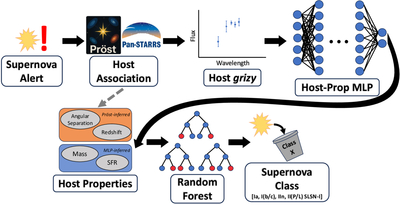
Caption: Figure 1.
The SPLASH pipeline architecture. When an SN alert occurs, it is associated with a galaxy in the Panoramic Survey Telescope and Rapid Response System (Pan-STARRS) catalog using the Pröst probabilistic host-galaxy association software. If a redshift is not provided in the catalog, Pröst will provide an estimate of the host’s redshift. The host galaxy’s grizy photometry is then fed into a multilayer perceptron (MLP) that infers its stellar mass and star formation rate (SFR). These inferred properties, the redshift, and the host–SN angular separation are then passed into an RF, which classifies the SN. The classes of the SNs that we infer are Type Ia, I(b/c), IIn, II(P/L), and Type I SLSNe (SLSNe-I).
Other Images in This Article
Copyright and Terms & Conditions
© 2026. The Author(s). Published by the American Astronomical Society.

