

Image Details
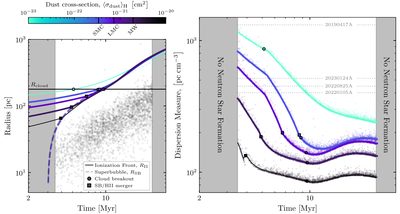
Caption: Figure 4.
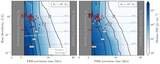
The dependence of the semianalytic, constant ionizing flux FRB DM model on the effective Lyman-continuum dust absorption cross section, ﹩{\langle {\sigma }_{{\rm{dust}}}\rangle }_{{\rm{H}}}﹩. The left panel shows the evolution of the H II-region radius, RII(t) (solid), and superbubble radius, RSB(t) (dashed), for a range of dust opacities, with the curve color corresponding to ﹩{\langle {\sigma }_{{\rm{dust}}}\rangle }_{{\rm{H}}}﹩ as indicated by the color bar. The horizontal black line marks the parent-cloud radius, Rcloud. Circles mark the cloud-breakout time (see Section 2.5), and squares mark the spectroscopic binary (SB)/H II merger time for each model, after which the dashed RSB curve is replaced by the merged shell radius. All simulations used a fiducial M⋆ = 106 M⊙. The right panel shows the dispersion measures of the corresponding Monte Carlo FRB sight lines as a function of activation time, colored by ﹩{\langle {\sigma }_{{\rm{dust}}}\rangle }_{{\rm{H}}}﹩ as in the left panel. The source-frame dispersion measures of a subset of high-DM FRBs (20190417A, 20230124A, 20220825A, and 20220105A) are indicated for comparison using the data of S. Yamasaki et al. (2026). See Section 4.4 for a detailed description of the sample.
Other Images in This Article
Copyright and Terms & Conditions
© 2026. The Author(s). Published by the American Astronomical Society.

