

Image Details
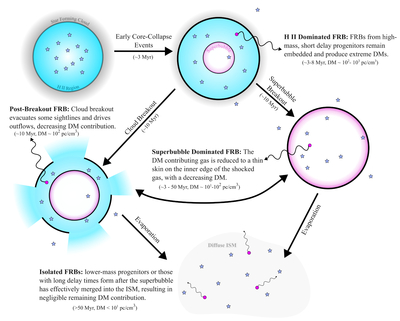
Caption: Figure 1.
The schematic evolution of a young massive stellar association embedded in a cluster-forming molecular cloud, illustrating the principal FRB environments considered in this work. During the early H II-dominated phase, neutron stars formed in the first core-collapse events remain embedded within the dense ionized gas and can acquire large association-scale dispersion measures. The subsequent evolution can proceed through either photoionization-driven breakout of the H II region from the parent cloud or the growth of a mechanically driven superbubble. Cloud breakout opens low-density escape channels and reduces the ionized-gas column, while superbubble expansion evacuates the central volume and sweeps the gas into a dense shell whose DM contribution declines as the shell expands. At later times, after the natal cloud has dispersed or the source has dynamically separated from the association, the FRB enters an isolated-remnant phase in which the local dispersion measure is expected to be dominated by its supernova remnant, circumstellar environment, or the diffuse host-galaxy ISM. The pathways shown are schematic and need not occur in a unique temporal sequence.
Other Images in This Article
Copyright and Terms & Conditions
© 2026. The Author(s). Published by the American Astronomical Society.

