

Image Details
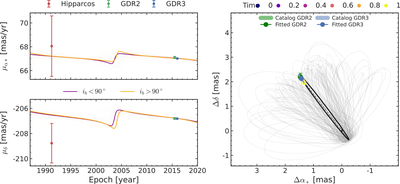
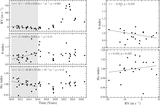
Caption: Figure 5.
Solution for Hipparcos-Gaia astrometry for HIP88962. Left panel: proper-motion evolution of HIP88962 predicted by the joint fit. The thick purple and orange curves show the instantaneous model proper motion for the two inclination branches, ib < 90∘ and ib > 90∘, respectively, both of which include the fitted barycentric proper motion and time-dependent reflex proper motion induced by HIP88962 b. The red, green, and blue points denote the Hipparcos, GDR2, and GDR3 catalog proper motions with their uncertainties. Right panel: astrometric reflex orbit of HIP88962 induced by HIP88962 b. The plus sign marks the system barycenter. The thick black curve shows the best-fit orbit, and the thin gray curves show 100 MCMC posterior draws. The green and blue shaded regions indicate the barycentric-motion-subtracted uncertainty envelopes for GDR2 and GDR3. The green and blue circles mark companion-induced position offsets at the GDR2 and GDR3 reference epochs, and the associated solid lines show their evolution due to the fitted proper-motion offsets. The colored points along the black orbit show the model-predicted astrometric positions at the Gaia scanning epochs and are color-coded by normalized observing time, increasing from purple to yellow.
Other Images in This Article
Copyright and Terms & Conditions
© 2026. The Author(s). Published by the American Astronomical Society.

