

Image Details
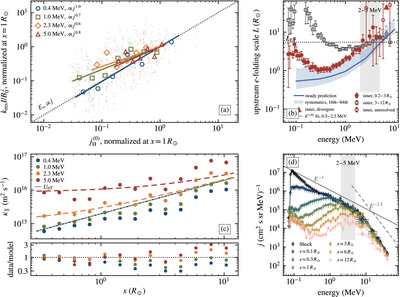
Caption: Figure 4.
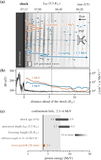
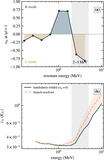
The wave-generation relation, the upstream scales, and the proton spectra of the precursor. (a) Resonant slab power ﹩{k}_{{\rm{res}}}I({k}_{{\rm{res}}})/{B}_{0}^{2}﹩ against the intensity j, both normalized at x = 1 R⊙, for four channels (legend): 15 s values (faint dots), medians in intensity bins (open markers), the fitted j g (solid), and the one-to-one relation g = 1 (dotted). (b)e-folding scale L in the inner (filled circles) and outer (open squares) windows with 1σ bars. Open circles mark unresolved inner fits and triangles divergent ones, filled above 2 MeV and open below. The dashed line is the power law of the inner scales, the solid line the scale of the steady profile on the measured κ∥(E, x) at ηTTD = 1 with its 16th–84th band, and the dotted line LEP. (c) Median-binned κ∥(x) at four energies (circles) and the model κ∥ = κ0 + U0x fitted on κ0 alone (dashed), with U0x in gray. The strip shows the ratio of the data to each model, dotted at unity. (d) Proton spectra at six upstream distances and at the shock from EPI-Lo (circles), LET (squares), and HET (triangles), with the adopted uncertainties as vertical bars and the LET and HET channel widths as horizontal bars. The gray band in (b) and (d) marks the 2–5 MeV transition of Paper II in the spacecraft frame.
Other Images in This Article
Copyright and Terms & Conditions
© 2026. The Author(s). Published by the American Astronomical Society.

