

Image Details
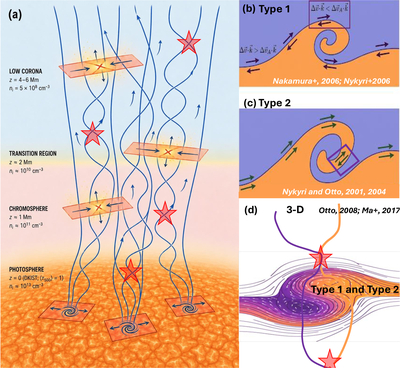
Caption: Figure 1.
A possible cross-scale path from photospheric KH forcing to the low corona through KH-driven reconnection and component reconnection. (a) A photospheric DKIST-scale tornado-like vortex acts at the footpoint of an expanding twisted magnetic structure at the magnetic-flux boundaries, with short horizontal, reconnecting current layers at several heights, locally perpendicular to the dominant guide field that extends from photosphere to corona. (b)–(c) Local 2D KHI-driven reconnection paths for preexisting antiparallel in-plane fields (Type 1) (T. K. M. Nakamura et al. 2006; K. Nykyri et al. 2006) and for initially parallel in-plane fields that are wound by KH vortex motion into compressed current layers (Type 2) (K. Nykyri & A. Otto 2001, 2004). (d) 3D paired “candy-wrapper” reconnection and twice-reconnected flux below and above the shear-flow plane (A. Otto 2008; X. Ma et al. 2017). The star symbol marks the location of 3D magnetic reconnection in panels (a) and (d). In panel (a), thin blue arrows along the long curved lines indicate the direction of the background magnetic field threading the flux concentrations. At each layer, converging blue arrows depict the in-plane convergence that compresses oppositely directed field components into a thin current sheet, with the red cross marking the reconnection site. Blue arrows directed away from the layers, along the background field, depict the field-aligned energy flux (heated-plasma enthalpy and wave Poynting flux) leaving the reconnection region in both directions; the fraction transmitted upward is the quantity ηup of Section 3. The plasma exhaust itself lies within each layer, along the reconnecting component bcs (Section 2).
Other Images in This Article
Copyright and Terms & Conditions
© 2026. The Author(s). Published by the American Astronomical Society.

