

Image Details
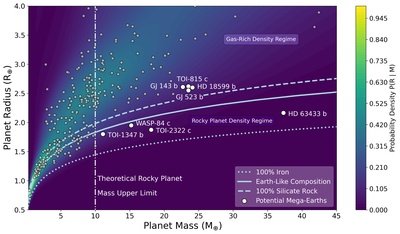
Caption: Figure 1.
Planet radii versus mass for small planets (<4R⊕) are plotted as gray points. Lines show mass–radius relations for planets with an Earth-like composition, a purely silicate-rock composition, and a purely iron composition (L. Zeng et al. 2019), representing the possible mass–radius space in which rocky planets can exist. Literature values come from the NASA Exoplanet Archive (R. L. Akeson et al. 2013), queried 2026 July 15 for planets with mass and radius measurements with fractional uncertainties <30%. The colormap represents the normalized probability density estimated from a Gaussian KDE. We show the theoretical maximum rocky planet mass threshold (10 M⊕) and identify planets above this threshold in the rocky planet density regime as possible mega-Earths (white circles).
Other Images in This Article
Copyright and Terms & Conditions
© 2026. The Author(s). Published by the American Astronomical Society.

