

Image Details
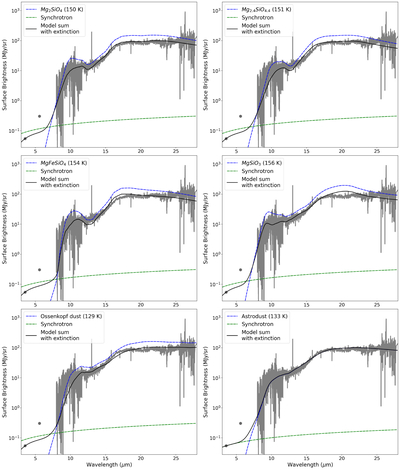
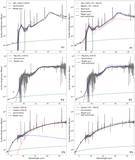
Caption: Figure A1.
Spectral fits to the P2 region using Mg-bearing silicate grain compositions with optical constants from C. Jäger et al. (2003a), silicates from V. Ossenkopf et al. (1992), and astrodust from B. S. Hensley & B. T. Draine (2023). The fits use a single-temperature dust component with foreground extinction. Gray circles represent the F356W and F560W flux densities from the same extraction apertures, while the green dashed curve represents synchrotron emission with an assumed power-law spectral index of −0.6 (V. Domček et al. 2021). The best-fit parameters for each composition are listed in Table A1. The Mg2SiO4 grains provide the best fit to the spectrum with line-of-sight extinction in the range measured by I. De Looze et al. (2017).
Other Images in This Article
Show More
Copyright and Terms & Conditions
© 2026. The Author(s). Published by the American Astronomical Society.

