

Image Details
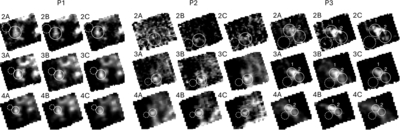
Caption: Figure 2.
Footprints of the MRS cubes at the P1, P2, and P3 positions (see Figure 1) for MRS channels 2–4. The wavelength ranges covered by the channels are 2A: 7.5–8.9 μm, 2B: 8.6–10.3 μm, 2C: 10.0–11.9 μm, 3A: 11.5–13.7 μm, 3B: 13.2–15.8 μm, 3C: 15.3–18.2 μm, 4A: 17.5–21.1 μm, 4B: 20.4–24.7 μm, and 4C: 23.9–27.9 μm. The emission is shown for a narrow wavelength range within each channel that is dominated by dust emission. The white solid circles represent the spectral extraction apertures for the chosen emission knots in each region, while the white dashed lines represent the extraction apertures for the local background. The solid-circle apertures have radii of 1﹩\mathop{.}\limits^{{\unicode{x02033}}}﹩0, while the background apertures have radii of 0﹩\mathop{.}\limits^{{\unicode{x02033}}}﹩7 at P1 and P2 and 1﹩\mathop{.}\limits^{{\unicode{x02033}}}﹩0 at P3. The resulting spectra are shown in Figure 3.
Other Images in This Article
Show More
Copyright and Terms & Conditions
© 2026. The Author(s). Published by the American Astronomical Society.

