

Image Details
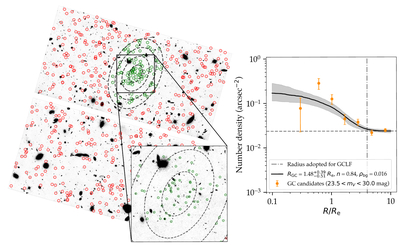
Caption: Figure 3.
Spatial distribution and radial surface density profile of GC candidates around DF44. Left: residual F350LP mosaic showing the compact sources selected as GC candidates within 4Re in green, and sources satisfying the same selection criteria outside 4Re in red. Dashed ellipses indicate multiples of the galaxy effective radius. The inset highlights the central region of the galaxy. Right: radial surface density profile measured in elliptical annuli aligned with the stellar body of DF44. Orange circles show the raw number density measurements, and the solid black curve shows the best-fit Sérsic model obtained with emcee. Radii are measured along the semimajor axis, in units of the stellar Re. The dashed vertical line shows the adopted radius inside of which we selected the GCs that will contribute to the GCLF. The fitted profile implies an extended GC system with ﹩{R}_{{\rm{GC}}}=1.4{8}_{-0.51}^{+0.39}{R}_{{\rm{e}}}﹩ and Sérsic index ﹩{n}_{{\rm{GC}}}=0.8{4}_{-0.24}^{+0.37}﹩. The dashed horizontal line shows the best-fitting background density of ﹩{\rho }_{{\rm{bg}}}=0.01{6}_{-0.006}^{+0.012}﹩ arcsec−2.
Other Images in This Article
Copyright and Terms & Conditions
© 2026. The Author(s). Published by the American Astronomical Society.

