

Image Details
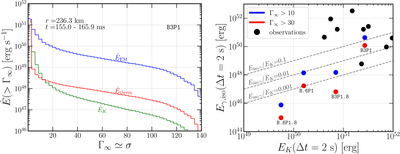
Caption: Figure 5.
Left: Cumulative distribution of wind luminosity ﹩\dot{E}﹩ in material above a given value of Γ∞ ≃ σ (Equation (A2)), for the most rapidly spinning, highly magnetized model (B3P1). The Poynting (﹩{\dot{E}}_{{\rm{EM}}}﹩, blue), thermal (﹩{\dot{E}}_{{\rm{therm}}}﹩, red), and kinetic (﹩{\dot{E}}_{{\rm{K}}}﹩, green) luminosities of the wind are measured at a spherical shell of radius r ≃ 236 km, between t ≃ 155−166 ms after magnetic-field initialization. Right: Total isotropic-equivalent energy carried by the outflow over a duration Δt = 2 s, in material with asymptotic Lorentz factor Γ∞ > 10 (Γ∞ > 30) shown with blue (red) points, versus total isotropic-equivalent kinetic energy of the outflow EK(Δt = 2 s), as measured from cumulative distributions shown in the left panel. Most of the energy in fluid with Γ∞ ≲ 10 resides in sub- or moderately relativistic wind components that would likely couple to the surrounding supernova or kilonova ejecta. Black points show inferred isotropic-equivalent energies of gamma-ray emission Eγ,iso and associated kilonovae EK from short GRBs compiled by J. C. Rastinejad et al. (2025), rescaled to a common duration of 2 s and assuming a jet half-opening angle θj,col ≃ 8° to match those found from the strongly magnetized, rapidly spinning wind models.
Other Images in This Article
Copyright and Terms & Conditions
© 2026. The Author(s). Published by the American Astronomical Society.

